Checkmate in the Heart of the Palace: When the Pawns Came to Life
An epic battle in 1924 where the streets of Leningrad became a living chessboard.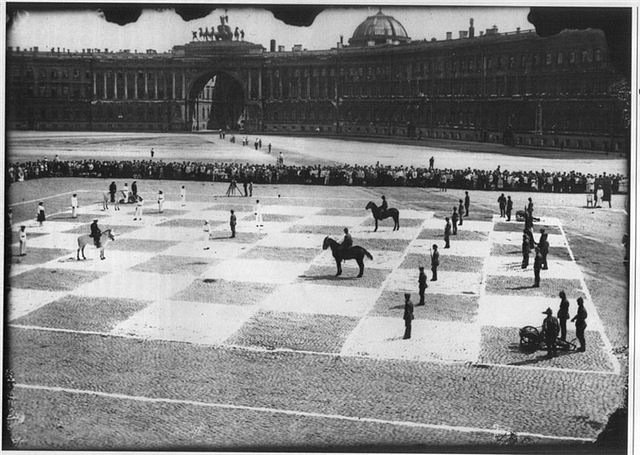
In the summer of 1924, Palace Square in Leningrad witnessed an unprecedented spectacle: a colossal game of human chess. This event was not just a game, but a demonstration of the Soviet passion for the science of sport after the revolution. On a giant board painted on the ground, two of the most brilliant masters of the time, Peter Romanovsky and Ilya Rabinovich, faced off in a mental duel that captured the imagination of thousands of citizens who gathered to watch every move.
The pieces were not wooden figures, but real people who brought the strategy to life on the concrete. The pawns were represented by Red Army soldiers, while the larger pieces, such as the rooks and knights, had elaborate costumes and real riders, lending an air of historical realism to the confrontation. Each instruction given by the masters was executed with military precision, transforming abstract tactics into an impressive visual display that turned chess theory into vibrant popular theatre.
The game lasted five hours of intense tension, with the knights crossing the black and white squares under the watchful gaze of the Winter Palace. Sailors from the Baltic Fleet also participated, symbolising the unity between the armed forces and the strategic intellect promoted by the new state. This event served to democratise chess, bringing it from private clubs to the masses and consolidating the idea that critical thinking and planning were fundamental tools for the modern Soviet citizen.
In the end, after a series of masterful manoeuvres and symbolic sacrifices, the match ended in a technical draw that left the huge crowd satisfied. Beyond the sporting result, the 1924 match went down in history as the greatest example of chess as a cultural and social phenomenon. On that day, the Palace Square was not only a battlefield of ideas, but also the stage where chess demonstrated its unique ability to unite art, sport and discipline in a single move.